



Hello everyone!
If you often do hole machining projects, do you often have questions like: Why my 10mm drill bit produce a 10.1mm hole? or Why my drill bits break so easily?
In most situations, the problem isn't insufficient drill bit hardness, but an invisible killer- radial runout.
In this article, we'll explain what is runout and why it matters in the simple words.
What is runout?
In short, runout refers to the wobble or shake of a drill bit during rotation.
Imagine a perfect rotation. When the drill bit spins inside the machine, its centerline should perfectly align with the machine spindle's centerline. At this point, the drill bit appears completely stationary and extremely stable.
However, if the drill bit is slightly misaligned or the machine chuck is not properly centered, the drill tip will trace a circular path as it rotates. The magnitude of this wobbling motion is called runout.
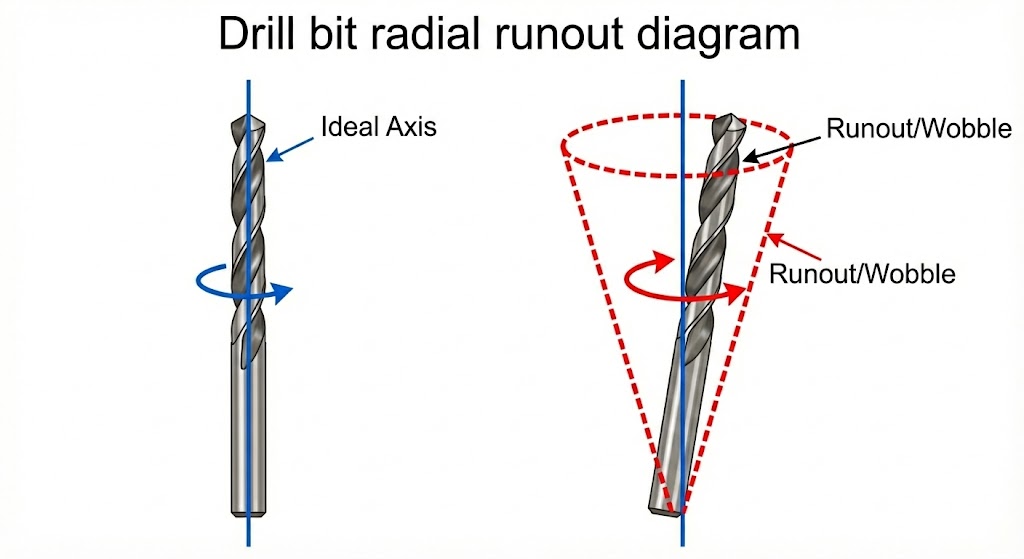
What are the drawbacks of runout?

For high-speed steel (HSS) twist drills, big runout is really bad. It causes a lot of problems:
1. Oversized holes (enlarged holes): This is the most common issue. Because the drill wobbles, it actually cuts a larger area than its own diameter.
2. Rough hole walls: The wobbling drill scrapes the hole's inner walls, resulting in a rough surface. The hole may even lose its roundness and become elliptical.
3. Reduced drill life: Uneven force distribution across the two cutting edges due to wobbling causes one edge to work too much, resulting in faster wear and dulling.
4. Increased risk of drill breakage: Radial runout generates significant vibration. When drilling deep holes, this vibration easily breaks the drill.
Why does runout happen?
Runout isn't always the drill bit's fault. It's usually a “system problem”:
• Machine tool or chuck issues: Is your drill chuck dirty with metal chips? Is the chuck badly worn? This is the most common issue. Improper clamping will cause the drill bit to wobble.
• Mounting issues: The drill bit protrudes too far or isn't clamped securely.
• Drill bit itself: Of course, some low-quality bits may be inherently bent or have asymmetrically ground cutting edges. especially, twist drills are made using two processes: rolling and grinding. Ground drills generally have better runout than rolled drills.
How to determine?
There are 2 main methods to determine drill runout: simple visual check and precise measurement. The most basic visual check is to mount the drill bit and rotate it at low speed and observe the drill tip with your eyes level. If the drill tip appears clear and stable, it is normal; if double vision, blurring, or a noticeable “spinning circle” enlargement occurs, it indicates a large runout.
A more precise method involves using a dial indicator (or micrometer): first clamp the drill bit securely, then position the indicator probe against the cutting edge or smooth shank area. Manually rotate the spindle one full circle and record the difference between the maximum and minimum values indicated by the pointer. This difference represents the total indicator runout (TIR).

Our suggestion
When manufacturing high-speed steel twist drills, we have strict testing standards for the straightness of the drill body and the symmetry of the cutting edges, ensuring that every drill bit meets precision standards before leaving our factory.
Also, a good horse deserves a good saddle. To achieve perfect drilling results, please remember to regularly clean and check your machine tool chuck!
If you have any questions during machining, feel free to contact us anytime.
Post time: Dec-10-2025